Diagnostic Uncertainty in German: Precise Phrases for Case Presentations
In a medical-language presentation, precision is more useful than theatrical certainty. A suspected diagnosis is not a confirmed finding; an unanswered question is not a negative result.
FaMed supplies the information for its patient presentations and does not separately assess medical knowledge.
Name the source and degree of certainty
Use the wording that the task supports:
| Information in the material | Possible German phrasing |
|---|---|
| Patient reports a symptom | „Die Patientin berichte über …“ |
| A finding is documented | „Im vorliegenden Befund wird … beschrieben.“ |
| A suspicion is stated | „Laut Aufgabeninformation besteht der Verdacht auf …“ |
| A diagnosis is confirmed in the source | „Als gesicherte Diagnose ist … angegeben.“ |
| Information is absent | „Hierzu liegen mir keine Angaben vor.“ |
These are practice formulations, not prescribed official sentences.
Use alternatives without inventing a conclusion
If the assignment contains alternatives, introduce them clearly:
- „Als weitere Möglichkeit wird … genannt.“
- „Die Befunde erlauben laut Bericht noch keine eindeutige Zuordnung.“
- „Zur Klärung ist im vorgegebenen Plan … vorgesehen.“
If you offer an interpretation in a practice exercise, label it as your interpretation. Do not report that an investigation was performed or ordered when it was not.
A fictional language exercise
Source note: a patient reports breathlessness after an operation; the supplied note describes a suspected embolism and planned further investigation. No result is given.
Die Patientin berichte über nach einer Operation aufgetretene Atemnot. Im vorliegenden Bericht wird der Verdacht auf eine Lungenembolie genannt. Die weitere Abklärung sei geplant; ein Untersuchungsergebnis liegt in dieser Übung nicht vor.
This exercise practises source accuracy, not the clinical diagnosis or exclusion of embolism.
Keep connectors proportionate
„Dafür spricht …“ indicates supporting information; it does not mean „beweist …“. „Dagegen spricht …“ does not automatically mean „sicher ausgeschlossen“. Practise that difference using only the facts provided.
Use SBAR as an organising aid, then compare the recorded presentation with its source. For patient-facing questions, see the history guide.
Sources and review
Editorial check: 18 October 2026, human medicine. Official exam flow, Current human-medicine practice test. Practice examples are created by FaMED Prep; they are not predictions of exam questions.
Join the Community
Share study questions and find preparation resources.
Plan your FaMED preparation
Your complete eight-week preparation guide. Enter your details to start the download and receive a backup link by email.
Get the free guideContinue Reading
For further practice
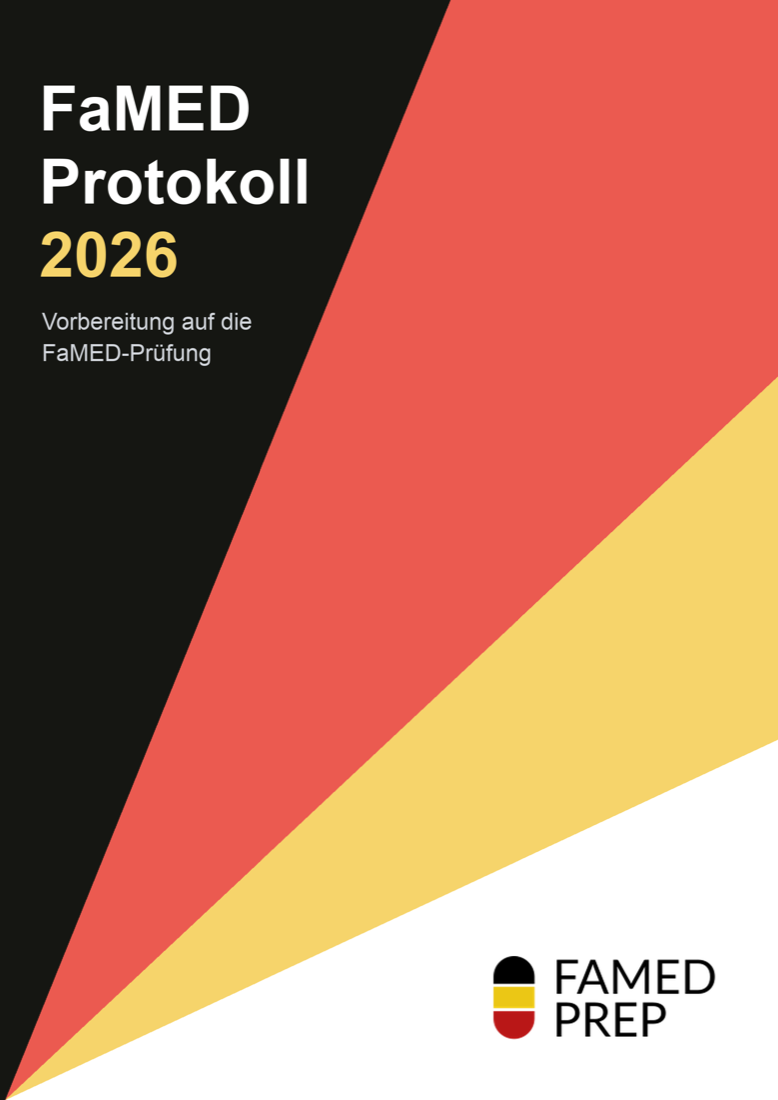
FaMED Protokoll 2026
A digital book in German with cases, useful phrases and conversation structures. An optional resource, separate from the app.
Get the digital book
FaMED Prep App
Explore practice for history taking, informed consent, case presentations and writing, and see how feedback can support your next attempt.
How the app works →